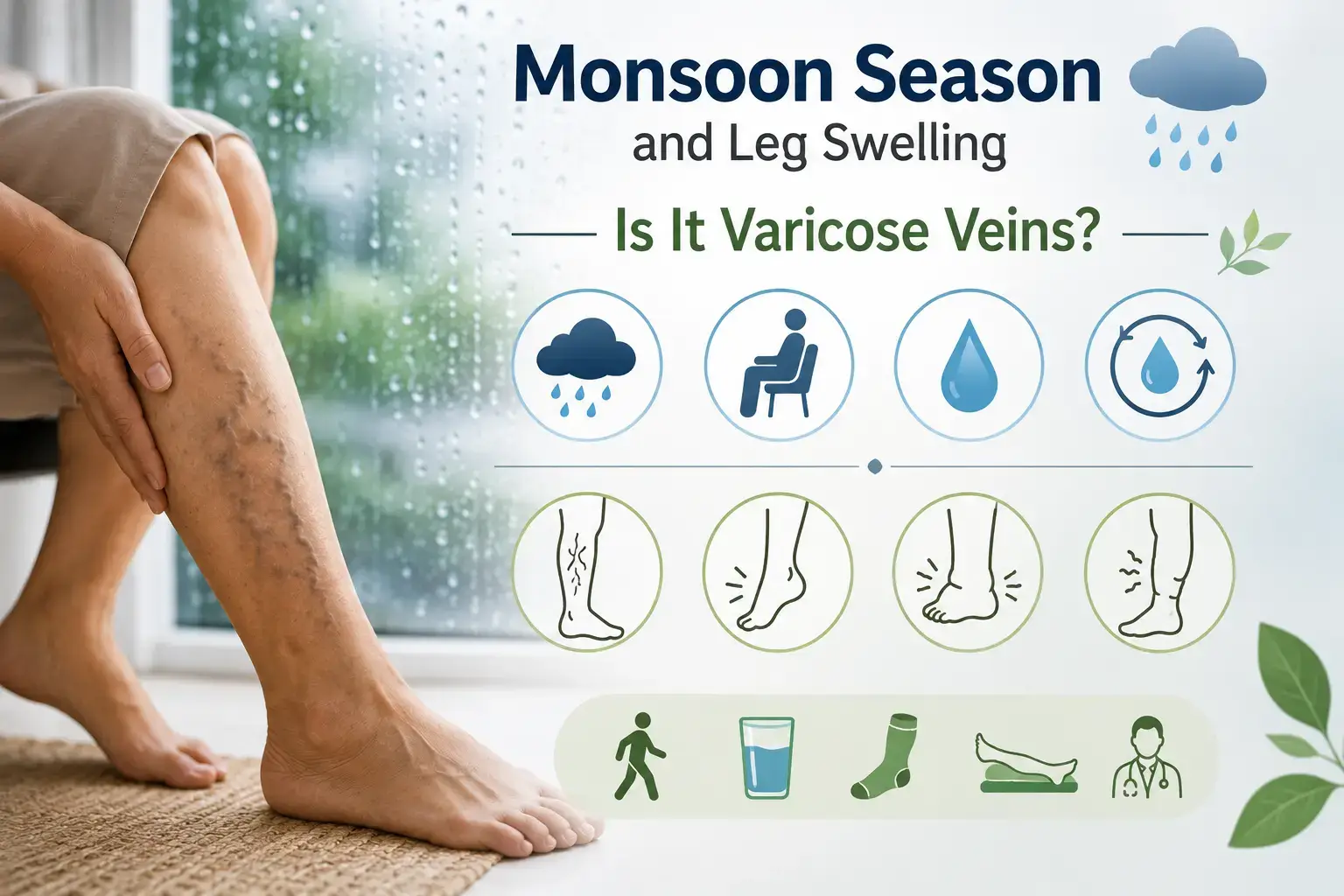
Monsoon Season and Leg Swelling: Is It Varicose Veins?
The monsoon brings with it a welcome break from the scorching summer heat the smell of wet earth, a warm cup of chai, and the sound of rain against the window. But for many people, it also brings something less welcome: heavy, swollen legs that ache by the end of the day.
If you’ve noticed your legs puffing up more during the rainy season, you’re not imagining it. This is an extremely common complaint, and it has a lot to do with how our bodies respond to monsoon conditions. But here’s the question most people don’t think to ask is that swelling just a seasonal thing, or could it be a sign of varicose veins?
Let’s break it down in simple terms.
Why Do Legs Swell More During the Monsoon?
Before we talk about veins, it helps to understand why the monsoon season makes swelling worse in general even in perfectly healthy people.
Humidity is the main culprit. When the air is heavy with moisture, your body finds it harder to regulate fluids. The blood vessels near the skin surface tend to expand in humid conditions, and fluid can leak out into the surrounding tissue more easily. This is what causes that puffy, tight feeling in your feet and ankles.
We also move less. Let’s be honest on a rainy day, most of us are not going for a walk or climbing stairs. We sit longer, rest more, and stay indoors. When your legs are inactive for long periods, blood naturally pools in the lower limbs, causing swelling and heaviness.
Barometric pressure changes the shift in atmospheric pressure that comes with overcast, rainy weather can also cause tissues to expand slightly, adding to the feeling of fullness in the legs.
So yes, some degree of leg swelling during the monsoon is completely normal. But there’s a line between “seasonal puffiness” and something that needs attention and varicose veins are often on the other side of that line.
What Are Varicose Veins, Exactly?
Your veins have a job that requires constant effort pushing blood upward from your legs back to your heart, against the pull of gravity. To do this, they rely on a series of tiny one-way valves that open to let blood through and then close to stop it from flowing back down.
When these valves weaken or stop working properly, blood starts to pool in the vein. The vein stretches under the pressure, becoming enlarged, twisted, and visible under the skin. These are varicose veins and they’re far more common than people realise, affecting nearly 1 in 3 adults at some point in their lives.
They most commonly appear on the calves and inner thighs, and while they can look alarming, many people live with them for years without realising they have a treatable condition.
How Is Varicose Vein Swelling Different from Normal Monsoon Swelling?
This is the most important question and the answer lies in looking at the bigger picture.
Normal monsoon-related swelling:
- Tends to affect both legs equally
- Usually improves after a night’s rest or when you put your feet up
- Comes and goes with the weather or your activity levels
- Doesn’t come with pain, skin changes, or visible veins
- Is worse at the end of the day but much better by morning
Swelling linked to varicose veins:
- May be more pronounced in one leg than the other
- Doesn’t fully go away even after resting overnight
- Is often accompanied by a heavy, tired, or achy feeling in the legs
- May come with itching, burning, or a throbbing sensation
- You might also notice dark bluish or purplish veins visible under the skin
- Skin around the ankle may look slightly discoloured or feel harder over time
- Gets noticeably worse during the monsoon and in hot, humid conditions
If you’re nodding along to several points in that second list, it may be time to pay closer attention.
Warning Signs You Shouldn't Ignore
Varicose veins are often dismissed as a cosmetic problem “just some visible veins” but they can progress over time if left untreated. Here are signs that warrant a proper check-up, especially if they appear or worsen during the monsoon:
Persistent leg heaviness — A dragging, fatigued feeling in the legs that doesn’t improve even after a full night’s rest.
Swelling that doesn’t go down — If your ankles or calves are still swollen in the morning, that’s not normal seasonal puffiness.
Leg cramps at night — Frequent cramping, especially in the calf muscles, can be associated with poor venous circulation.
Skin changes — Any darkening, hardening, or discolouration of the skin around the ankle or lower leg needs prompt attention.
Itchy or irritated skin over a vein — This can be a sign of a condition called varicose eczema, where the skin above a poorly functioning vein becomes inflamed.
A vein that feels tender or warm to the touch — This could indicate a clot forming inside the vein (superficial thrombophlebitis), which needs to be evaluated quickly.
A sore or wound near the ankle that won’t heal — In advanced cases, varicose veins can lead to venous ulcers, which are open sores that are slow to heal. These always need medical attention.
Who Is More at Risk?
While varicose veins can affect almost anyone, certain factors increase your chances:
- Family history — If your parents or grandparents had varicose veins, your chances are higher
- Standing or sitting for long hours — Teachers, healthcare workers, IT professionals, drivers, and homemakers are particularly at risk
- Pregnancy — The increased blood volume and pressure on pelvic veins during pregnancy can trigger varicose veins
- Being overweight — Excess weight puts added pressure on the venous system
- Age — Vein walls and valves naturally weaken over time
- Women — Hormonal fluctuations make women more susceptible, particularly during pregnancy or with hormonal medication
The monsoon doesn’t cause varicose veins on its own but it can unmask symptoms that were quietly brewing beneath the surface.
What You Can Do Right Now
Whether you’re dealing with normal seasonal swelling or something more, here are a few things that genuinely help:
Keep moving. Even a 10–15 minute indoor walk makes a difference. Ankle circles, calf raises, and gentle stretching improve circulation without needing to brave the rain.
Elevate your legs. When resting, prop your legs up on a pillow so they’re above the level of your heart. Even 20–30 minutes of this a day helps drain pooled blood from the lower limbs.
Watch your salt intake. The vada pavs and pakodas that monsoon tempts us with are delicious but often loaded with salt, which worsens water retention. Balance it out.
Wear compression stockings. If your doctor has recommended these, the monsoon is exactly the time to wear them consistently. They provide gentle pressure that supports your veins and reduces swelling.
Stay hydrated. Counterintuitively, drinking enough water actually reduces water retention by keeping your kidneys and circulatory system working efficiently.
Avoid standing or sitting in one position for too long. If you work at a desk or spend long hours on your feet, make a habit of shifting position and taking short breaks to walk around every hour.
When to See a Doctor
If your leg swelling is new, worsening, or comes with any of the warning signs mentioned above don’t wait for the monsoon to pass. Varicose veins are a progressive condition, meaning they tend to get worse over time without treatment. The earlier you seek an evaluation, the more treatment options are available to you, and the simpler the process tends to be.
Modern treatment for varicose veins is minimally invasive, quick, and highly effective. Most procedures are done on an outpatient basis, with little to no downtime meaning you could be back on your feet (literally) the same day.
The Bottom Line
Some leg swelling during the monsoon is normal and harmless. But if your legs feel persistently heavy, achy, or swollen or if you can see or feel enlarged veins it’s worth getting a professional opinion.
At Surekha Varicose Veins, we see a significant increase in patients during and just after the monsoon season, because this is when symptoms become impossible to ignore. Our team of experienced specialists can help you understand exactly what’s going on with your veins and guide you toward the right solution — whether that’s lifestyle changes, compression therapy, or a minimally invasive procedure.
Don’t let swollen legs slow you down this monsoon. Come in for a consultation, and let’s get to the root of it together.
Book your appointment with Surekha Varicose Veins today. Because healthy legs aren’t a luxury — they’re something you deserve.
Consult Now
Consult Dr. Ashish Dhadas at Surekha Varicose Veins Clinic to receive expert evaluation and personalized treatment.
Surekha Varicose Veins Clinic
Address: 2nd Floor, Surekha Varicose Veins Clinic, Swara Emerald, Dr R.P. Rd, Tilak Nagar, Dombivli East, Thane, Dombivli, Maharashtra 421201
Phone: 094038 90477
Book your consultation today and take the first step toward pain-free, healthier legs.